How to Ski Tignes & Val d'Isere by Train

Updated: Jan 13
Discover the more comfortable, greener, and scenic route to some of the world's best skiing.
Tignes and Val d’Isere are two of my favourite and most frequented ski resorts. I’ve been lucky enough to ski Val with mates regularly over the last few years, and Tignes is a regular destination for work – just check out my season diaries if you needed more proof!
Alongside around 300km of pistes shared between the two resorts, there is some of the world’s best off piste skiing available. Much of it is lift accessible, too, including one or two off piste, out-of-resort runs (yes that is a thing) that are served by dedicated lifts, something truly special and almost unique to this area.
They are both imminently accessible by train as well. This greener, more comfortable, more relaxed and cheaper (yes, it really is) option is well worth considering. And whilst myths abound about the complexity of booking and travelling by train to the Alps, it is no more complicated than booking a flight - only most people are far more familiar with flying!
This is Skiing Unlocked’s guide on how to ski Tignes & Val d’Isere by train.

Where to Go
There are some many places to ski in France by train, Tignes and Val d’Isere are but two of a long, long list of French resorts available.
There are two benefits of choosing these two resorts; firstly, the high quality of the ski areas and large resort footprints, meaning everyone is catered for on and off piste.
Secondly, the local railhead – Bourg-Saint-Maurice, or Bourg for short – is served by the “ski train” from London. Take the Eurostar to Lille, get off and wait on the same platform, and another train will pull up a few minutes later to take you all the way to Bourg.
The ski train also serves railheads for Les Arcs and Sainte Foy (also Bourg), La Plagne (Aime La Plagne) and the Trois Valles (via Moutiers-Salin-Bride-les-Bains, or Moutiers for short). Some of the World’s best, let along France’s best ski areas are served by this Saturday morning direct train from Lille.
The other way to access these destinations is changing across Paris – arrive by Eurostar at Paris Gare du Nord, take the RER line D (similar to the Metro) two stops to Paris Gare de Lyon, and take one TGV (high speed) train from there to Bourg, Aime, or Moutiers.
Changing across Paris also opens up a huge variety of destinations not available from Lille. TGVs run to Annecy for La Clusaz; Geneva and Zurich for a huge range of Swiss Resorts; Cluse and St Gervais for Morzine, Flaine, St Gervais itself, and Chamonix. Further south, trains run through Briancon (for Serre Chevalier) to Italy and the Via Lattea, bring Sauze d’Oulx and Sestriere into the mix. There really are endless possibilities to ski by train in France – a good place to explore all these is with Snowcarbon.

Planning Your Journey
Buying tickets and planning your journey could not be easier, and certainly a helluva lot easier than when I tried (successfully) to ski Japan by train!
The best bit about skiing by train in France is that the bulk of the travel can be booked in one go. You can use a variety of booking platforms to book the travel from London St Pancras International to Bourg on one ticket.
I prefer to use booking portal of the French national rail operator, SNCF. This is a little counterintuitive as it asks you to put in a destination and hit search first, before entering such important details as to where you are coming from and when you want to go – effectively the reverse of every other train ticket booking platform known to man …
However, once over these hurdles, SNCF offers clear pricing, a clean UX, and decent connections.
Other options include the Eurostar website itself and The Trainline. All of them are able to compute itineraries from London to Bourg via Lille, or leaving plenty of time (c.90mins) to travel across Paris, and sell the journey as one ticket.
The two things you can’t sort as part of this is the travel across Paris (if you’ve chosen that route) and the travel from Bourg to Tignes or Val.
Metro tickets in Paris can be bought from ticket machines on the metro level concourse at Gare du Nord – simply head down the escalators from the main concourse to the metro station concourse, and there are a number of self-service ticket machines to purchase your tickets.
You’ll need to purchase a “Navigo” card, Paris’ equivalent of an Oyster card, for 2EUR, then add single journeys for 2.50EUR each. The tickets are valid on any service in Paris, including Metro and – ideal for us – the RER. The RER journey is short, at only two stops and taking 10 minutes, and trains run every 10 minutes, making the journey short and sharp.
At the other end of the journey, the leg from Bourg to resort. For all destinations – not just Tignes and Val but La Clusaz, Meribel, Courchevel, Morzine and many, many more – there is an excellent, superb, second-to-none coach network.
These buses run from coach stations attached to the railway stations – literally attached – to resort. Buses are timed to meet trains, and will wait if your train is late. Tickets are cheap, too, at less than 20EUR return. To view timetables and to book tickets, head to altibus.com
For train tickets – sncf-connect.com
For bus tickets – altibus.com
For Metro and RER tickets – buy these from the ticket machines at stations.
A really good alternative guide is that from The Man In Seat 61, available here.

Itineraries
There are two trains that leave London St Pancras International each Saturday morning to take you to the Alps: 6:31am and 9:01am. These meet connections in Paris and Lille, respectively, to get you to the Alps in time to meet buses to resort.
There are also trains at 7:04am, 7:31am, and 8:01am – Eurostar and SNCF don’t include these in direct itineraries as they don’t offer good connections in Paris for trains to Bourg, either with less than the 90min changes the recommended routes offer, or they simply don’t line up entirely.
This doesn’t mean they’re useless: the 8:01am train, for example, is perfect for making connections to Annecy. But as we’re focusing on Bourg and Tignes/Val d’Isere, let’s stick to the 6:31 and 9:01am.
Station | Train 1 | Train 2 |
London St. Pancras International (dep.) | 06:31am | 09:01am |
Lille (arr.) | - | 11:23am |
Lille (dep.) | - | 11:56am |
Paris Gare du Nord (arr.) | 09:53am | - |
Metro/RER Transfer | c.30 minutes | - |
Paris Gare de Lyon (dep.) | 11:30am | - |
Bourg-Saint-Maurice train station (arr.) | 4:37pm | 6:02pm |
Bourg-Saint-Maurice bus station (dep.) | 5:00pm | 7:00pm |
Val d'Isere - La Daille Gare Routiere (arr.) | 6:00pm* | 8:00pm* |
Tignes (le Lac) (arr.) | 6:00pm* | 8:25pm* |
*Tignes and Val are normally served by different buses (Train 1), sometimes by the same bus that will call at Val first followed by Tignes (Train 2).
Ticket prices can vary considerably – book early and book separate legs separately, and you can do it for less than £100 each way, including one leg in first or business class! Like planes, ticket prices are variable, increasing in price the closer to departure date. Around £150 each way is to be expected.
The benefit of booking through tickets via Eurostar or SNCF are that the connections are guaranteed; if your first train is late so that you miss your connection, you can take any subsequent train using the same ticket for no extra cost - just speak to staff to make these arrangements.
The Experience
I’ve done this journey, either whole or in part, several times now, but the most recent trip was done in December 2025. This was done early season before the above timetables came into effect, so I took a bit of a different route that involved an additional change at Chambery – a useful alternative if the main routes are fully booked, you fancy an adventure, or trying to reach an awkward destination. My route was roughly following Train 1, the 06:31am train via Paris.
I arrived at St Pancras and checked in around half-5 that morning for the 06:31am train; because of new border controls being brought in by the EU, you are assigned an arrival time to make sure no-one misses their train!
All bags must go through x-ray scanners although, unlike airports, you can bring unlimited sized liquids with you. This is a bit awkward with ski bags, but it does work. You can also bring up to two bags free of charge – beat that, EasyJet!
A word now on ski bags. A glance at the Eurostar website says that skis can be brought if they are less than 85cm, which you and I both know is absurd. Luckily if you keep digging a bit more, this is the maximum permitted size for general luggage and skis of any size can be brought with you – I have never been harassed for bringing my skis, and this time I brought two pairs! The one thing to note is that, on Eurostar at least the only luggage space for them is in the overhead racks, so whatever you bring make sure you can lift it over your head by yourself.
From there, into the departure lounge which has a shop and a couple of cafes. Your train’s platform will be announced and you simply head up the travellators, find your carriage, and board.
The journey to Paris is fairly uneventful. A lot is made of being able to watch the world go by on the train rather than staring at the seat in front of you on the plane, and whilst this is invariably true and a huge difference, much of the landscape of France that you pass through is a bit … dull.
There’s plenty of luggage space, although ski bags have to go in the overhead racks. Seats are comfortable enough and there are two on-board cafes for tea, coffee, and snacks.
Upon arrival in Paris, take your time getting off the train, especially if you have bags - hopefully your train is on time, but either way the time given to change across Paris is 90 minutes, more than enough to take it easy even in the event of disruption.
The way to the RER is very clearly marked; simply follow the large, dark green “D” signs to find the right line. There are lifts and escalators to take you down to the metro-station level, then simply keep following the dark green “D” signs. Purchase your ticket and head for the southbound platforms (“sud” in French). When you reach the platform level, line “D” trains depart from the left-hand platform.
These trains are double-decked and hugely long, but as we’re only going a couple of stops I tend to get on and hang around by the doors; again, plenty of space for luggage and ski bags, and for people to move around you at the only intermediary station. RER trains on line “D” run every 10 minutes, and take 10 minutes, meaning this transfer can take as little as half an hour in total – on occasion when my Eurostar was late, I have done in the absolute minimum 20 minutes, although that was a proper steeplechase!
Gare du Lyon is a bit of a mess; follow the signs for “Trains Grand Lignes” (mainline trains) out of the metro/RER station, and then check your ticket. Your train will depart from one of three “Halls”, labelled 1, 2 and 3. Halls 1 & 2 are up at ground level, a little distance apart, Hall 1 the original, beautiful Victorian-era train station (which uses letters for platform designations) and Hall 2 a handful of platforms stuck on the side, which uses numbers instead. Hall 3 occupies the basement level between the metro/RER station and ground level – it serves all platforms, and is used to ease overcrowding in the two halls above.
There is a really clear and useful guide to Gare du Lyon available via the Man in Seat 61 here.

Once you’ve located your platform, find your train, your carriage and your seat. Many TGVs these days are double-deckers, which whilst great for squeezing more people in can be very … compact.
This is where you have to be smart in selecting seats. If travelling in First Class – which may only be a few quid more than Standard – then aim for lower deck seats in coach 1. There are two disabled/buggy spaces in this carriage and, when not in use, make for excellent storage areas for ski bags!
Small ski bags will fit in overhead luggage racks, otherwise the best place for large or double ski bags on a double-deck TGV in Standard Class is at the top of the stairs, in front of the “extra” seats by the luggage rack – here they can lie flat with enough space for people to pass.
Again, the seats on the TGV are comfortable, with huge table space for a laptop. The café’s are decidedly French, with space to perch and stand whilst you sip your coffee or beer – a slice of Parisian café culture at 300kph. The journey whisks you through equally non-descript French countryside as on the way to Paris, and in around five hours you’ll arrive into Bourg-Saint-Maurice,
It cannot be easier to get to the bus station from the platforms at Bourg. At one end is access to the Les Arcs funicular, however we’re going the other way. Pass through the station building and out onto the square in front of the station, and the bus stands are there on your right hand side. So easy! The buses to Tignes and Val d’Isere are the S82 and S83, and they leave from the stands closest to the station building.
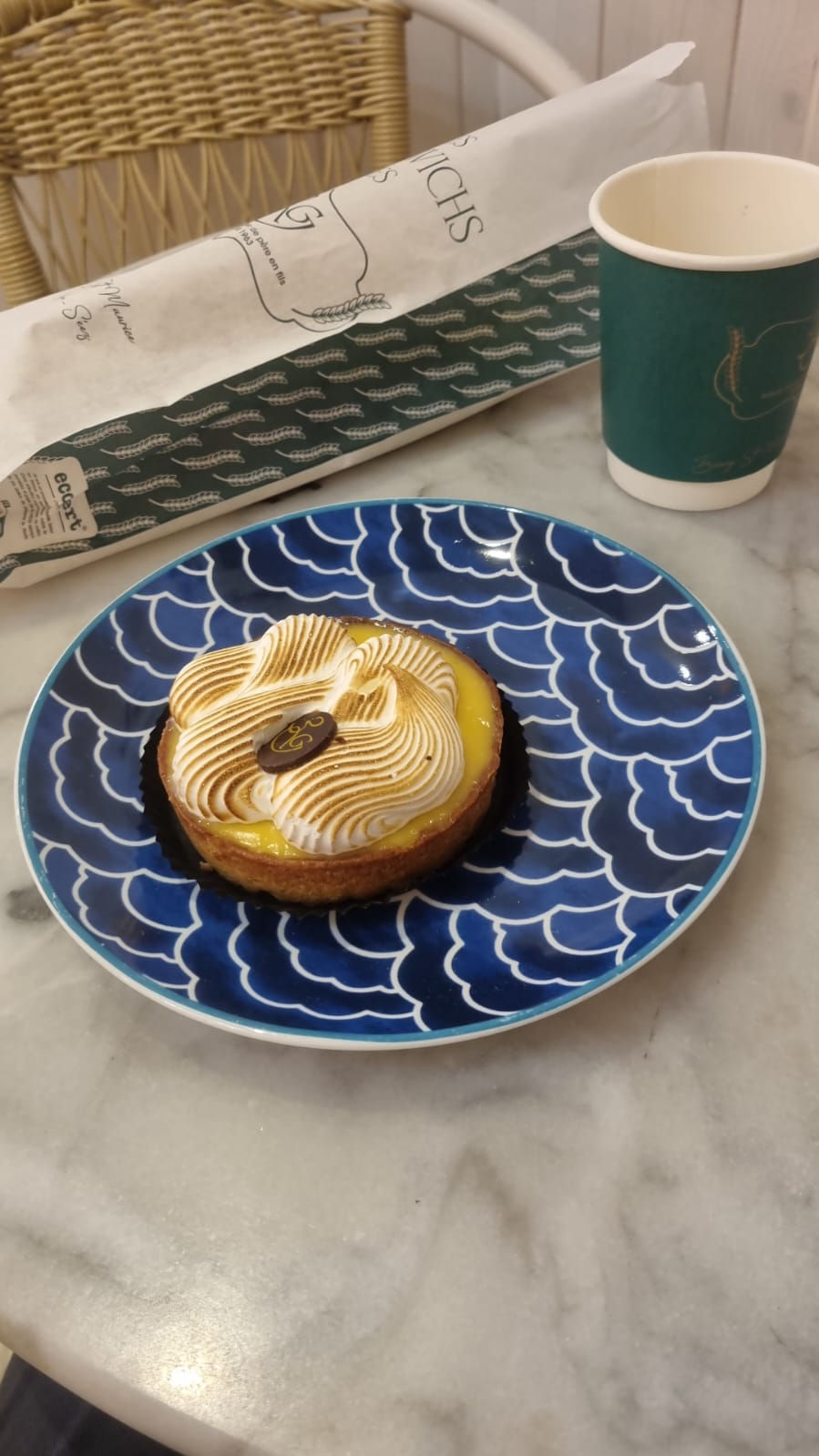
A little trick for killing time in Bourg – there’s a left luggage service run from a hut on the side of the square by Bourg station. Drop your bags here, then cross the road, go round the corner, and walk up the main street. In two minutes you’ll arrive at Boulangerie 3G that does the most delicious sweets, cakes, sandwiches and coffees, perfect to stretch your legs after sitting on the train and a little “sweet treat”, too. I’ve started booking my buses an hour later (or earlier on the way home) to give myself time to swing by Bourg’s secret cake shop!
Finally, hop on the bus. It takes around 45-minutes to go direct to either Tignes or Bourg, and the traffic has almost always thinned out by this point. The bus will stop in all Tignes villages, starting at 1500 and going up to Val Claret; in Val, the bus station has now moved to the edge of town at La Daille, where the free resort shuttles take you the rest of the way into town.
And that’s it!

Final Thoughts
This is a particularly long piece of mine, as there are a couple of “chokepoints” that can need finessing along the way. I won’t try and pretend that Gare du Nord and Gare de Lyon are simple stations to navigate, but then half of the airports that I travel through are equally confusing.
But I am a firm believer that taking the train is the best way to reach the Alps. The booking process is as simple as flying, including booking transfers at the other end. The price is about the same, when bags and seat reservations on airlines, and the cost of getting to and from the airport are factored in. And it is infinitely more relaxing to sit on a train, sleep, work, have a coffee. As if to prove this point, my watch buzzed and told me I hit 10,000 steps at 11pm on this travel day, when I was working around my hotel room unpacking – when flying, I normally hit this at 11am.
There’s also the environmental argument. Flying to resort contributes 66% of the carbon emissions of your ski holiday. By taking the train, you can cut the contribute made by travel to just 10%. I try to refrain from making the environmental argument as it can immediately turn people off - which is bullshit, frankly. Instead, focus on the other postives; it is more relaxing, it can be cheaper, and yes it can be longer than flying but my god is it more relaxing.
Taking the train to Tignes and Val d’Isere is one of the best adventures you can have, for so, so many reasons, and we all need to do more of it.